Skilled trades becoming a growth market for exoskeletons.
‘SUITX by Ottobock’ expands sales reach and partnerships across Europe.
Friday, 2 October 2026
The skilled trades sector is becoming a key growth market for exoskeleton provider ‘SUITX by Ottobock’. A shortage of skilled workers, an ageing workforce and high levels of physical strain are driving demand for solutions that support employees in their day-to-day work. The company is therefore expanding its activities in the construction and skilled trades sectors. An important partner in opening up this market is Adolf Würth GmbH & Co. KG, a specialist in the skilled trades and industry: its international sales and advisory network gives skilled trades and construction companies practical access to exoskeletons.
“The skilled trades sector is undergoing far-reaching change. Companies need to attract skilled workers, retain experienced employees for longer and remain competitive at the same time,” says David Duwe, Vice President SUITX by Ottobock Europe. “Occupational health and safety is therefore becoming an economic factor. Exoskeletons reduce physical strain and help make working conditions more attractive, particularly where technical or organisational measures alone are not sufficient.”
Expanding access through strong partners
To make exoskeletons more widely accessible in the construction and skilled trades sectors, ‘SUITX by Ottobock’ is expanding its sales and advisory network across Europe. Its collaboration with Würth is an important part of this strategy: thanks to Würth’s extensive branch network and personal advice from local sales representatives, companies can explore the technology in their region, receive guidance and test it in specific applications.
In Germany, exoskeleton solutions are already available at more than 90 Würth branches, with the offering set to expand to more than 100 locations by the end of 2026. A significant expansion is also planned in France, where the solutions are expected to be available at 240 branches by the end of March 2027 to meet growing demand. Other European markets are set to follow.
“Our customers expect solutions that prove their value in day-to-day operations,” says Stefan Schneid, Sales Manager for Occupational Safety at Adolf Würth GmbH & Co. KG. “Exoskeletons are still a relatively new product category, making personal advice and hands-on testing particularly important. Through our branch network and the close support provided by our specialists at customers’ premises, we offer exactly that access and guide companies from their initial enquiry through to use in the workplace.”
Practical benefits for the skilled trades
The right solution for a company depends on the tasks involved and the associated physical strain. The IX BACK AIR exoskeleton from the IX series, for example, supports the lower back during lifting, bending and carrying. Complementary products from the CX series provide targeted relief for other areas of the body, including the neck, wrists, knees and back. Workplace analyses and practical trials help companies identify suitable applications and integrate exoskeletons effectively into existing workflows.
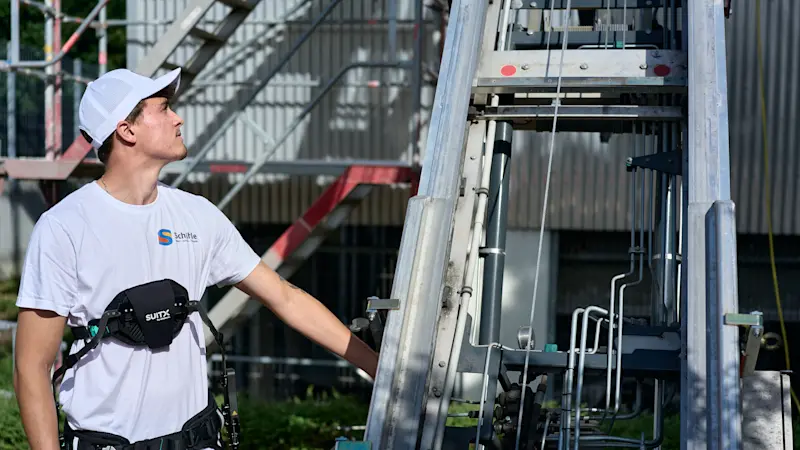
Roofing and waterproofing company Schühle Abdichtungen in Reutlingen, Germany, shows how this works in practice. Its employees already use exoskeletons for physically demanding tasks. “For us, it was crucial that the exoskeletons could be integrated into our daily workflows with minimal effort,” says Hansjörg Schühle. “Companies that want to retain skilled workers for the long term need to invest in their health. Exoskeletons help reduce physical strain and show that innovation is now an integral part of the skilled trades.”
The German Social Accident Insurance Institution for the building trade (BG BAU) also supports workplace trials of back- and shoulder-support exoskeletons. This allows skilled trades companies to test the technology under real-world conditions and use it specifically where it supports employees in their day-to-day work.
Established in industry and logistics
Beyond the skilled trades, exoskeletons from ‘SUITX by Ottobock’ have already proven their value across numerous sectors. IKEA, for example, uses the technology for lifting and carrying tasks in the consumer goods sector. In logistics, Hermes Germany and DB Schenker use exoskeletons for physically demanding work. MAN Truck & Bus deploys them in the commercial vehicle industry, including for maintenance and repair work, while Airbus uses them in aviation. Experience from these applications highlights the potential of exoskeletons for physically demanding work in the skilled trades.