iconiq: Individualized liner from a 3D printer.
Digital planning, additive manufacturing: residual limb problems affect up to 68 per cent* of prosthesis users – and this is exactly where the new silicone liner comes in.
Wednesday, 27 May 2026
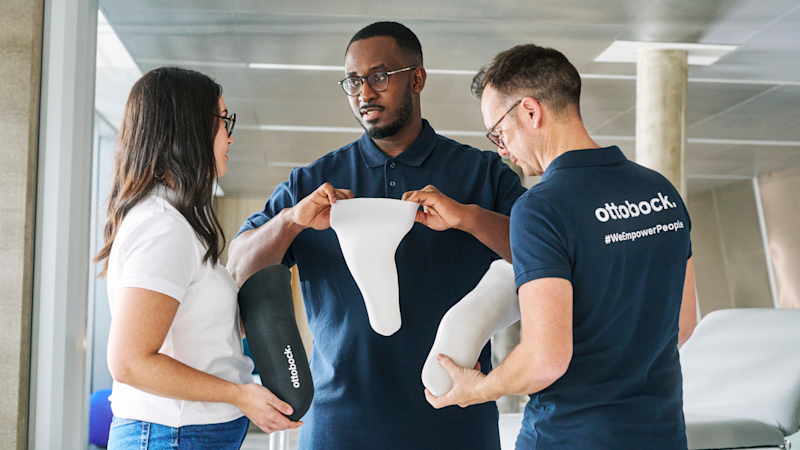
Almost 68 per cent of leg prosthesis users have problems with their prosthesis. There are many causes, from pain or sores on the residual limb to physical reactions such as skin irritation. During this time, prostheses can be used only to a limited extent or not at all. The liner is the invisible base of a well-fitting leg prosthesis. It is crucial in terms of comfort, safety and mobility. This is a consumer product that needs to be replaced approximately every six months. In the past, O&P professionals had to choose between standardised liners with limited customisation options for their patients or complex and costly custom fabrications. With iconiq, Ottobock’s first 3D-printed silicone liner, the medtech champion is taking custom fittings to a new industrial level. The liner made its German premiere last week at OTWorld in Leipzig. The market launch will now follow gradually.
Oliver Jakobi, CEO/CSO of Ottobock, says: “The iconiq liner is an example of our strategy: to make our innovations available to as many users as possible, thereby providing them with high-quality fittings. The iconiq is another component in implementing this claim globally. With it, we offer an efficient solution without compromising on quality and precision.”
Redefining customised treatment.
“With iconiq, we are creating a future-proof solution that overcomes the existing conflict between standard solutions and customisation,” says Arne Jörn, CTO/COO at Ottobock. “We are industrialising customisation so that it no longer becomes the exception, but the norm in everyday care.”
The innovation focuses on additive manufacturing technology combined with an efficient digital process: a 3D scan of the residual limb is all it takes to generate a data set – without any markers or special equipment. The shape perfectly takes into account the user’s anatomy as well as sensitive areas and scar tissue. Once the residual limb length has been entered and the design selected on the Ottobock ordering platform, the data is transferred directly to the medtech company's production department. Production itself is carried out using 3D printing. This results in perfectly fitting, flexible liners without elaborate mould construction.
Designed for maximum requirements – provides simplicity for professionals.
O&P professionals benefit from consistent, reproducible results. As a result, customised liners can be produced faster, with improved planning and considerably less complexity.
With iconiq, users get a liner whose fit, shape and stability are precisely tailored to their individual needs. Different thickness profiles ensure uniform compression and a secure hold. The material properties are so versatile, even under high loads, that iconiq is suitable for users who have a very active or athletic lifestyle as well as for children and adults with mobility grade 2 and up.
* Internal market research study of Ottobock with 112 prosthesis wearers, 2023