Connecting Brain, Body and Technology: Advances in Upper Limb Prosthetic Care.
Online Symposium Highlights Progress in Surgery, Neuro-interfacing and Rehabilitation.
Monday, 12 October 2026
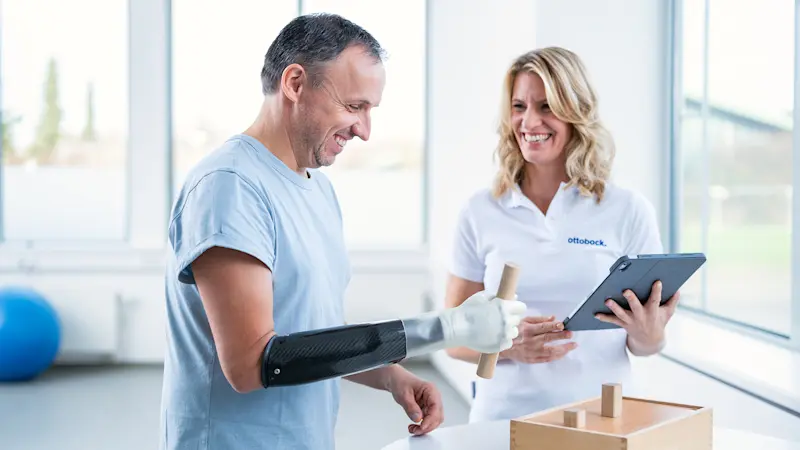
Advances in surgery, neural-interfacing and rehabilitation are opening new possibilities for people with upper limb loss. At an online symposium on 22nd September 2026, leading experts discussed how innovations across these fields are transforming treatment pathways and helping patients regain function, independence and participation in daily life.
Dr. Andreas Hahn (Corporate Vice President Clinical Research and Services, Ottobock Healthcare Products GmbH – Vienna, Austria), moderator of the event, emphasized the pace of progress: “It is fascinating to see how far upper limb prosthetic care has progressed, while at the same time recognizing that there is still so much potential ahead of us.”
Across different perspectives, the speakers shared one common message: the future of upper limb prosthetic care depends on strengthening the connections between brain, body, technology and the interdisciplinary healthcare teams supporting patients throughout their rehabilitation.
The Future of Amputation: Restoring Meaningful Connections.
PD Dr. Jennifer Ernst (Head of Division for Innovative Amputation Medicine, Clinic for Trauma Surgery, Hannover Medical School, Germany) outlined how amputation care has evolved beyond replacing a missing limb. Today, the focus increasingly lies on restoring functional connections between patients and their environment. She emphasized that amputation should no longer be viewed as a singular surgical event, but rather as the beginning of a lifelong care journey encompassing pain management, residual limb health, motor control, prosthetic integration and social participation.
Drawing on surgical innovations, including osseointegration, Targeted Muscle Reinnervation (TMR) and Agonist-Antagonist Myoneural Interface (AMI), Dr. Ernst described how surgeons increasingly contributing to design human-machine interfaces for more intuitive communication between brain, body and advanced prosthetic systems.
“The future of amputation medicine is not a better prosthesis alone. It is about a better connection between brain and body, body and technology, disciplines and ultimately the person and their life,” said Dr. Ernst.
The Interface Between Biology and Technology.
Prof. Dr. Oskar Aszmann (Director of the Center for Bionic Extremity Reconstruction, Medical University Vienna, Austria) explored the opportunities and limitations of combining biological and technological approaches in upper limb reconstruction. Through clinical examples he demonstrated how advanced reconstructive techniques can restore meaningful sensory and motor function.
Prof. Dr. Aszmann noted the substantial representaton of the human hand in the sensory motor cortex and pointed to the necessity of reconnection. To retrieve meaningful motoric function he emphasized the need of shared decision-making with the patients.
Advocating a “biology first” approach, Prof. Dr. Aszmann explained that techniques such as osseointegration and nerve transfer can provide additional treatment options when biological solutions reach their limits. Utilizing these techniques together with a muscular transfer has opened a recent breakthrough in treating neurologically depletedextremities and enhance the spectrum of reconstructive surgery further. While prosthetic capabilities advance specifically with the utilization of implant technology and continue to expand treatment possibilities, he noted that technology can support but not surpass biological function.
Rehabilitation Drives Patient-Centered Care.
Dr. Agnes Sturma (Head of Department of Health Sciences, University of Applied Sciences Campus Wien, Vienna, Austria) emphasized that limb loss affects not only physical function but also personal identity, making individualized rehabilitation and expectation management essential for successful outcomes.
Given the complexity of upper limb amputations and the rapidly increasing number of technological options today, Dr. Sturma advocated for shared decision-making processes that combine clinical expertise with patients’ personal goals, needs and preferences.
To view the recording of the symposium, please register by clicking on this link: Advancing Upper Limb Prosthetic Care – Surgical Innovation, Neural Interfacing and Rehabilitation.
After successful registration, the link to the recording will be sent in the confirmation email. The recording is available until 30th December 2026.
About Ottobock
Ottobock, a listed global MedTech champion, combines over 100 years of tradition with outstanding innovative strength in the fields of prosthetics, neuro-orthotics and exoskeletons. Ottobock develops innovative fitting solutions for people with limited mobility and is driving the digitalization of the industry. Founded in Berlin in 1919, the company has business activities in 45 countries with nearly 9,300 employees (FTEs) worldwide and operates the largest international patient care network with more than 430 patient care clinics. Ottobock is shaping the future of human bionics with a strong R&D ratio in the products and components business and over 2,600 patents and patent applications. Ottobock’s mission of improving freedom of movement, quality of life and independence is deeply rooted in the company's DNA, as is its social commitment: Ottobock has been a partner and supporter of the Paralympics since 1988.