
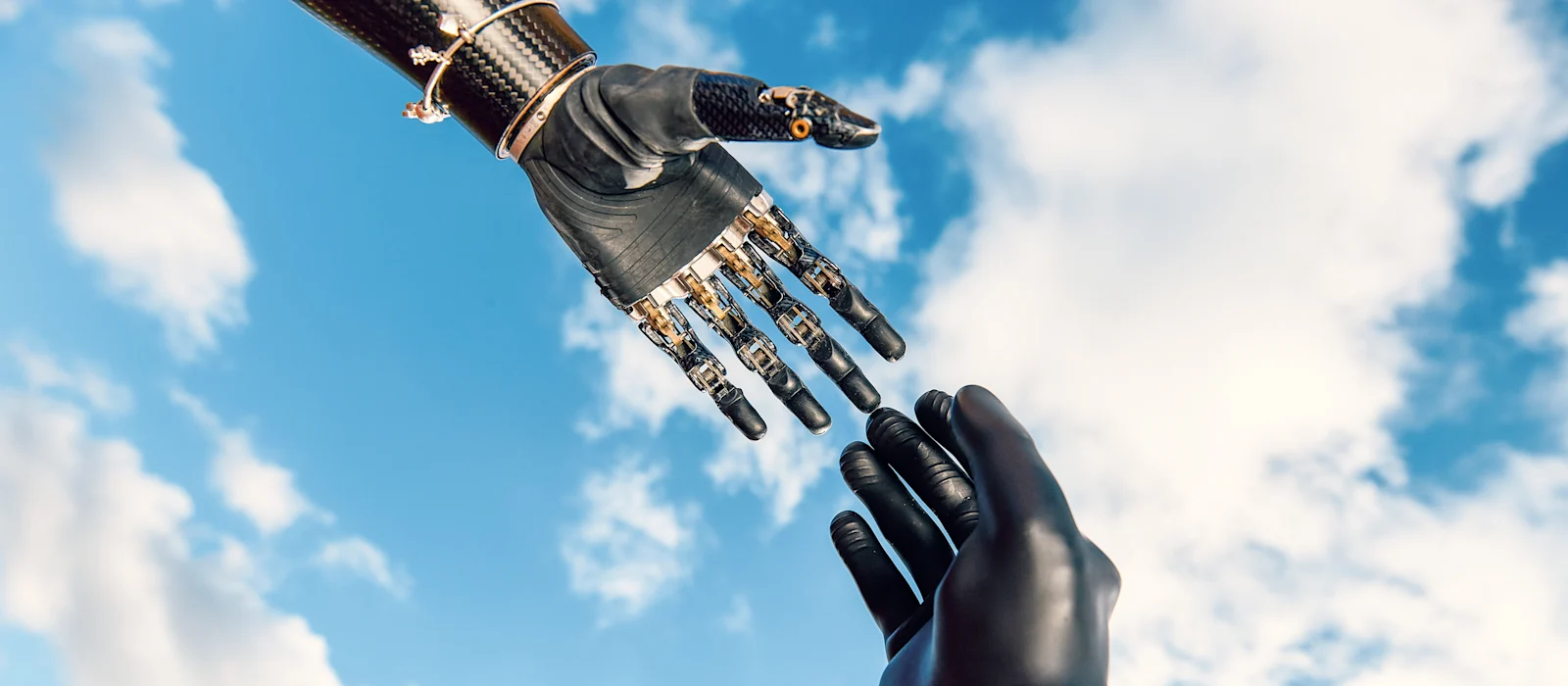
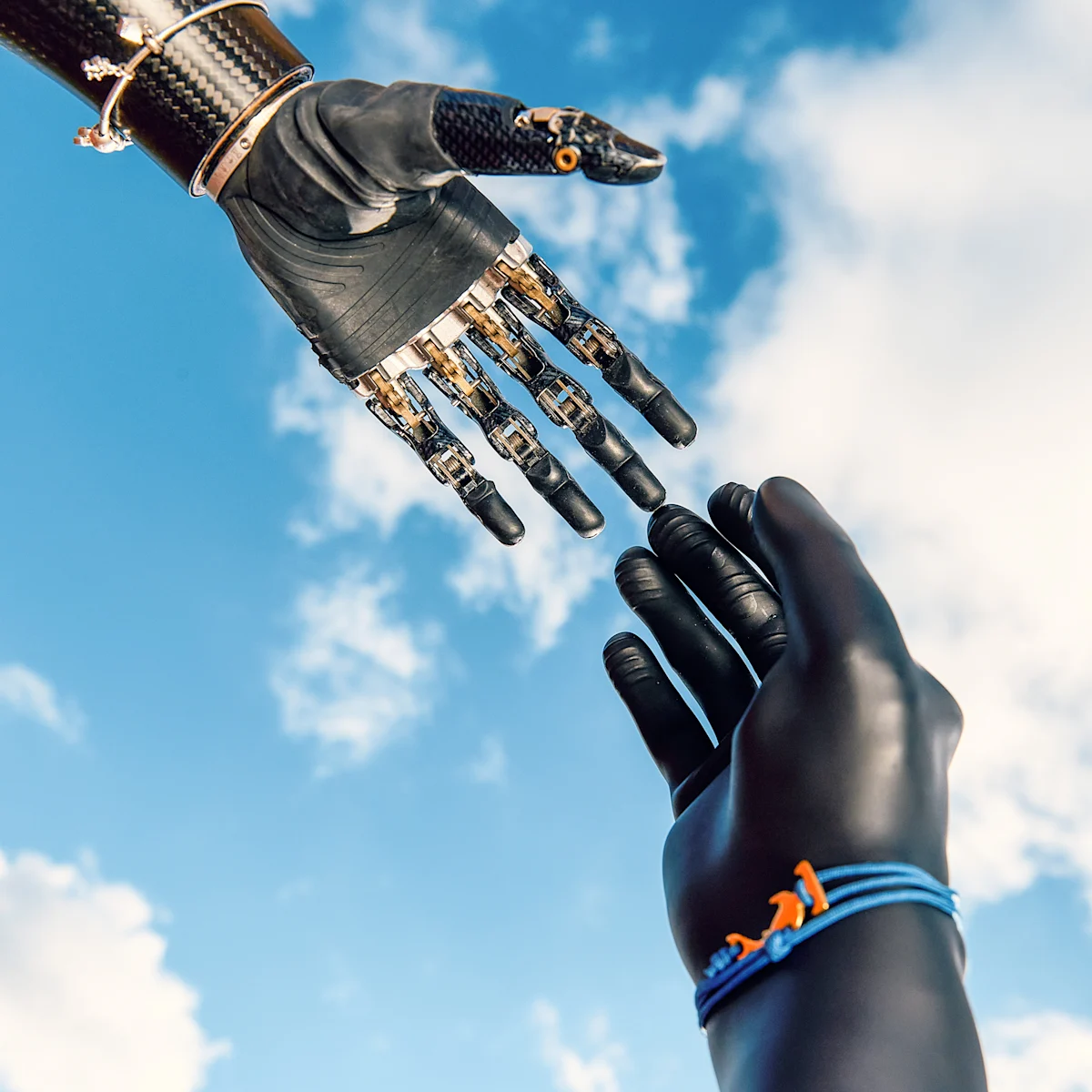
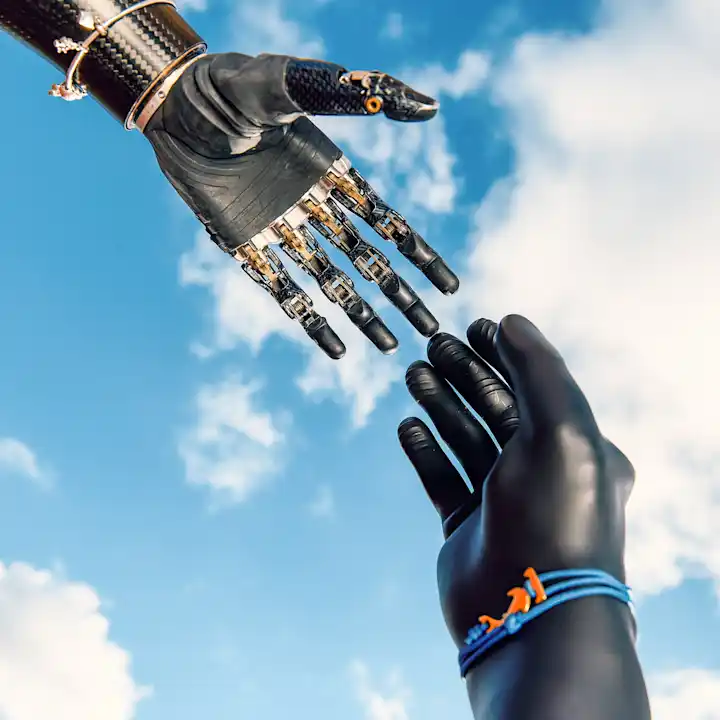
Intelligent hand prostheses.
How artificial intelligence recognises and automatically carries out hand movements.
How artificial intelligence recognises and automatically carries out hand movements.
How does a hand prosthesis know when to flex a finger and type on a keyboard? In the past, people with an amputation had to spend considerable time learning to control their prosthesis through targeted muscle tensing.
Today, artificial intelligence (AI) is fundamentally changing this approach: Modern hand prostheses identify intended movements based on pattern recognition of muscle activity. This allows the prosthesis to carry out various movements much more intuitively and without manual switching – an important step towards prosthesis control that is more natural and more functionally versatile.
AI-based pattern recognition – the new control standard.
The myoelectric control uses muscle impulses produced during natural movements, such as in the hand. Ottobock’s myosmart and myosmart plus prosthesis control analyses these signals and assigns them to specific movements.
The core principle:
The prosthesis learns from the person – not the other way around.
Non-invasive sensors in the prosthetic socket record the slightest muscle activity in the residual limb
Control learns the specific muscle activities in a “training process” from the user
In daily life, the AI analyses muscle signals in real time, recognises movement patterns and assigns them to specific prosthesis movements
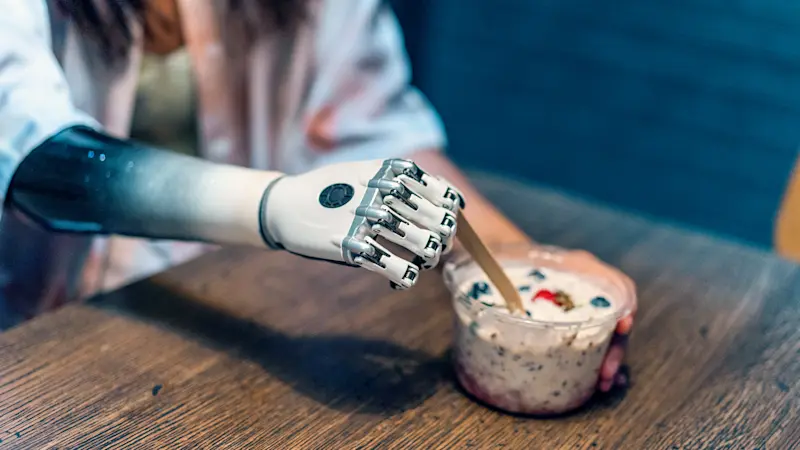
Intuitive gripping and rotation movements, e.g. gripping a spoon
Recognising, saving and retrieving movement patterns.
Orthotics and prosthetics (O&P) professionals and users can use the connectgrip app to individually adapt the control:
Visualisation of recorded muscle and movement patterns
Training for the targeted activation of movements
Movement patterns can be saved and customised
Targeted filtering of unwanted movements
Automatic fine-tuning of movement commands
The biggest challenge:
Many hand movements differ only to a minimal degree. myosmart has to reliably recognise and correctly assign the huge number of different patterns.
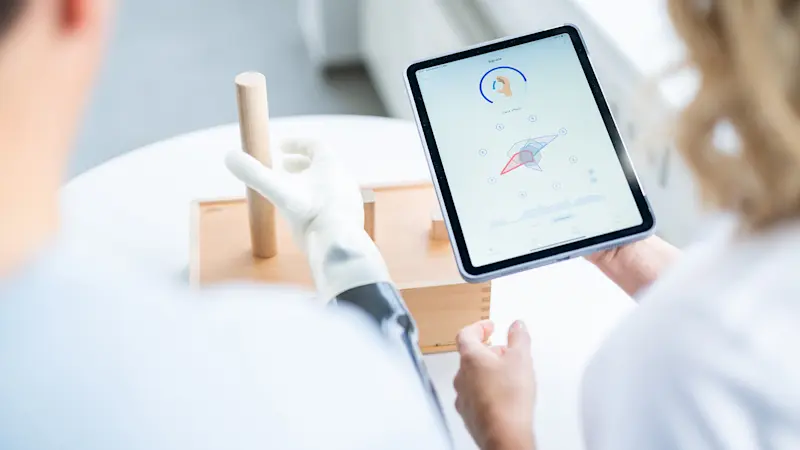
A control system for various prosthesis solutions.
The myosmart control is compatible with all Ottobock myoelectric hand prostheses:
myosmart plus for multi-articulated hands such as the bebionic and michelangelo
myosmart for the speedhand
For people with a shoulder and transhumeral amputation or dysmelia, O&P professionals therefore have the option to flexibly combine hands, System Electric Greifers and prosthetic wrist and elbow joints according to the users’ needs.
Always the right fitting solution.
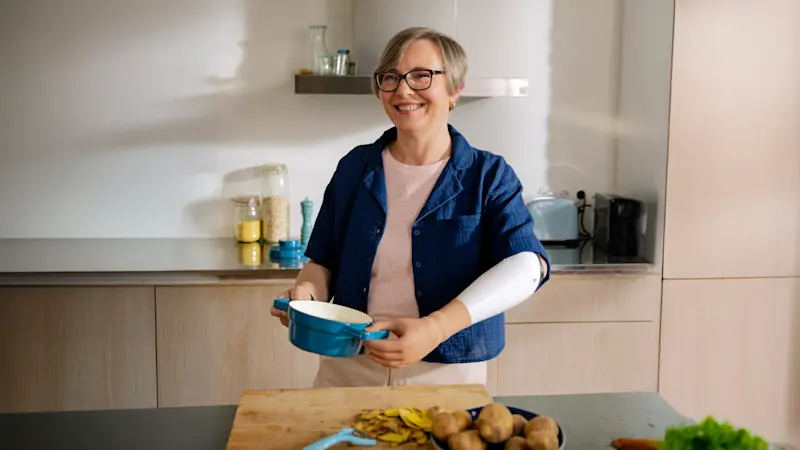
Nicky and the michelangelo
Nicky had to undergo a shoulder amputation as a teenager due to a tumour. Today she wears the DynamicArm together with the michelangelo hand prosthesis. She gave birth to her son in September 2025 and now combines being a mother with her passion for strength training, good food and cooking.
“Thanks to my arm prosthesis, I feel confident and can fully enjoy spending time with my child.”
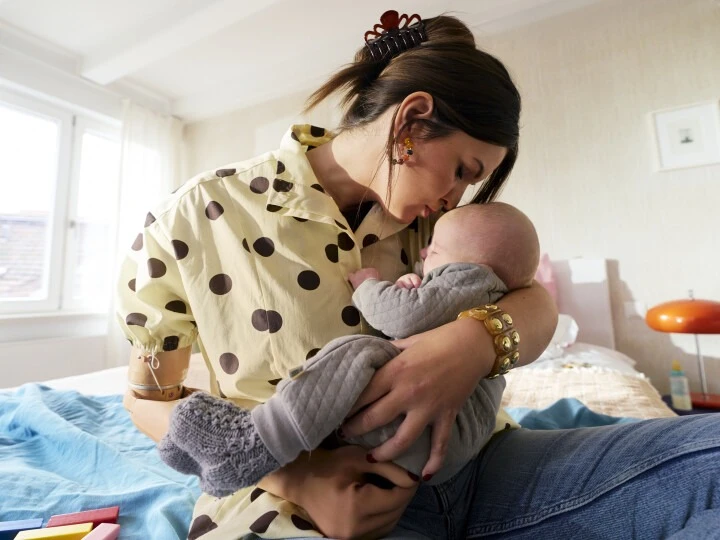
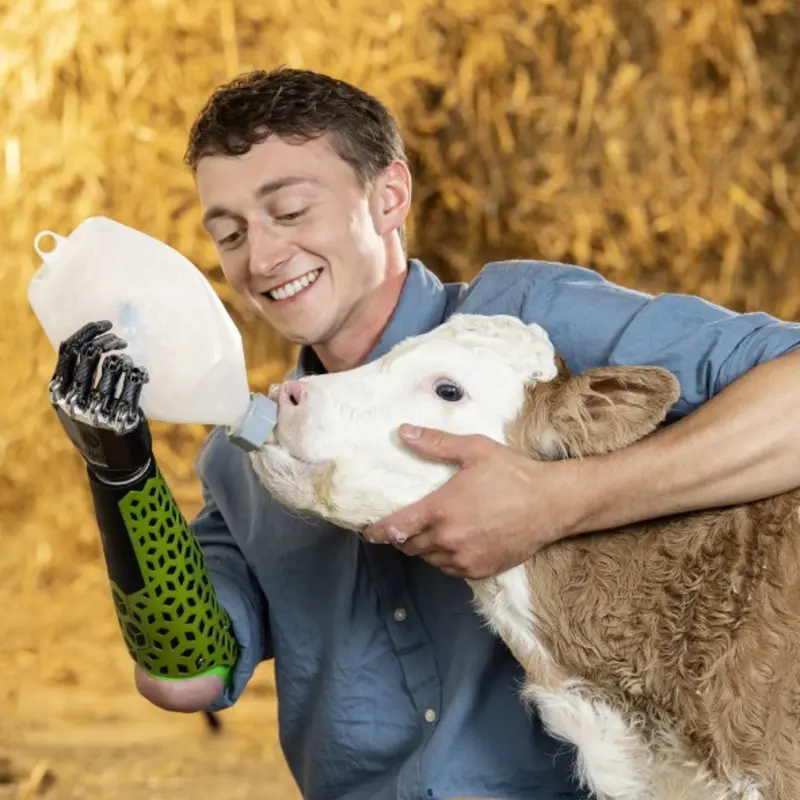
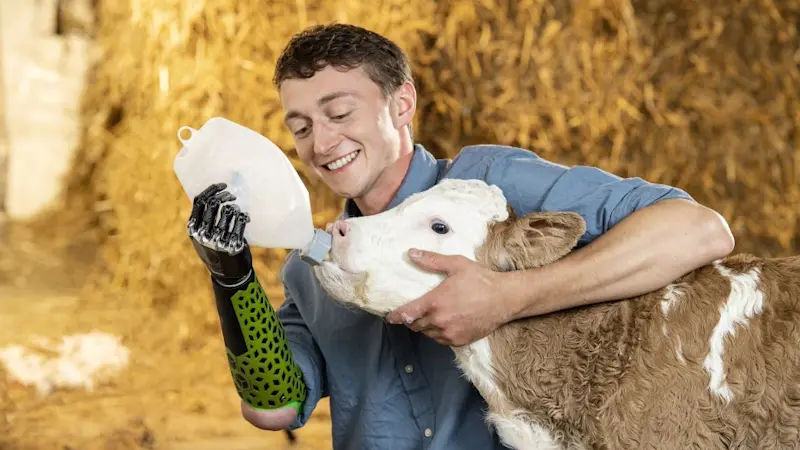
Gripping force combined with intelligent prosthesis control.
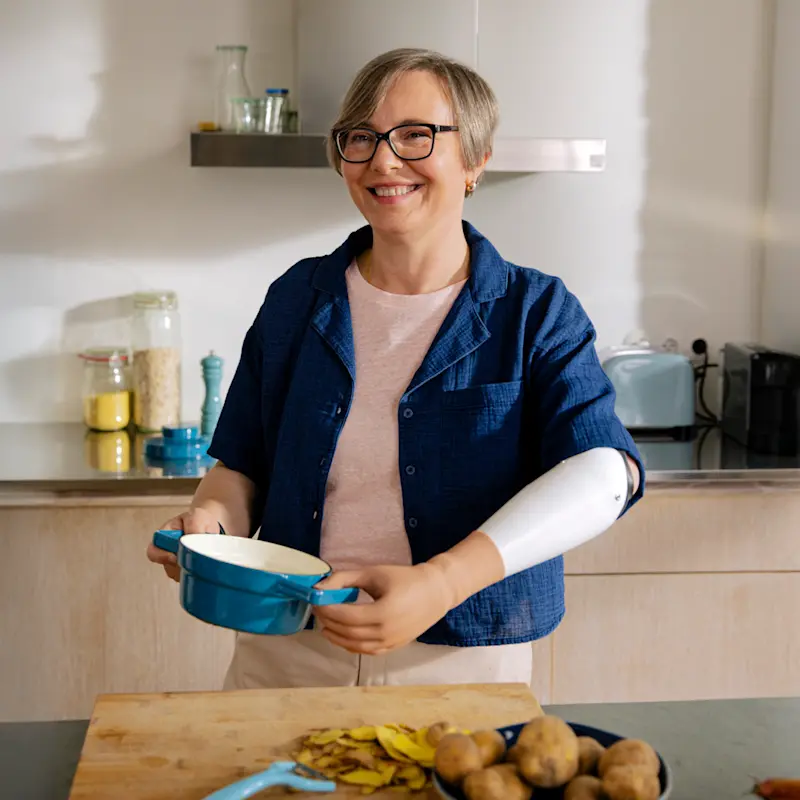
The technologically advanced michelangelo hand prosthesis combines its familiar mechanical performance with modern digital control.
Combining it with the AI-based myosmart plus prosthesis control and the connectgrip app produces a smart fitting solution:
Intuitive, AI-supported control
Support for natural movement patterns
Up to eight gripping and movement modes can be directly controlled
Targeted filtering of unwanted prosthesis movements
The michelangelo uses a combined principle of movement:
The thumb, index finger and middle finger are actively controlled
The ring finger and little finger passively follow the movements
The hand prosthesis therefore makes typical everyday movements possible, such as:
Gripping a bottle laterally
Grasping flat objects such as paper
Carrying a plate
Gripping a pen
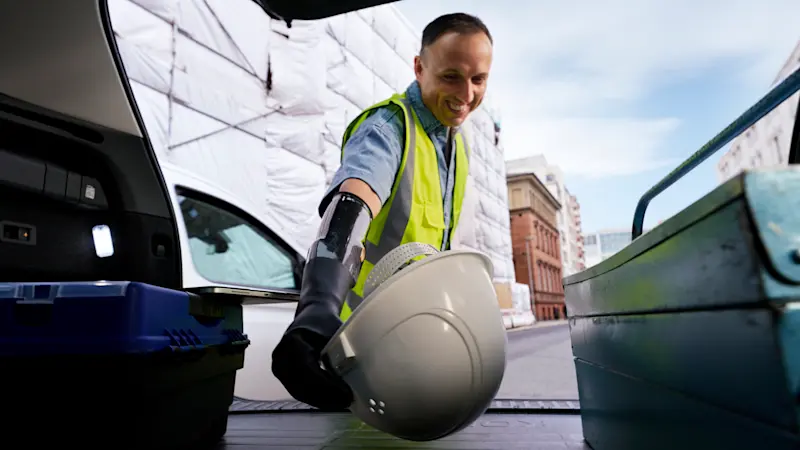
Hand movements without thinking twice – just like with a real hand.
The design of the michelangelo hand prosthesis combines functional robustness with a natural appearance.
The fingers are made of both soft and hard materials, and thus based on the natural hand down to the details.
Water-resistant prosthetic gloves in seven different skin tones allow users to personalise their hand. Coloured fibres on the inside simulate the natural vein structure of the human hand. For those who wish to show off their arm prosthesis, a transparent and a black prosthetic glove are available.
The new michelangelo hand prosthesis is now available for teenagers and women as well thanks to an additional S size.
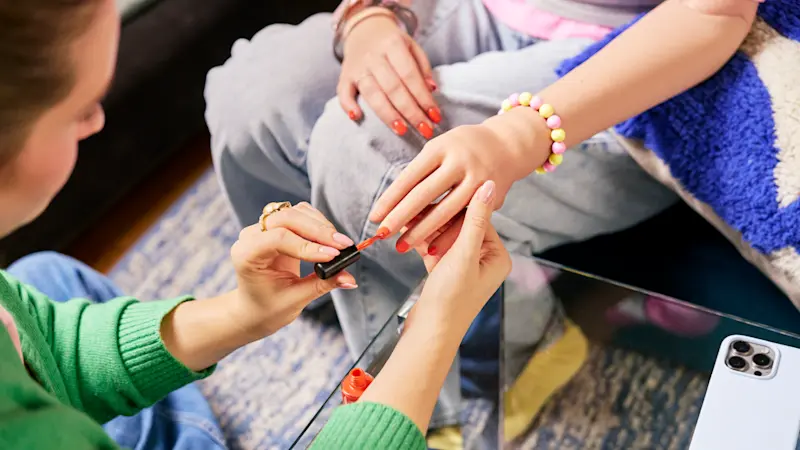
Paralympic swimmer Andreas Onea is wearing the new michelangelo prosthetic solution.
Austrian para-swimmer, TV host and inclusion ambassador Andreas Onea lost his left arm in a car accident at the age of six.
The Ottobock documentary “TWO. The Andreas Onea Story” follows his journey as he begins a new chapter in his life with a bionic arm, which opens up new possibilities for Andreas in his daily life, family life and career.
Andreas Onea is the first user worldwide to wear Ottobock’s new michelangelo prosthetic hand, myosmartplus controller and DynamicArm as a complete fitting solution.
“TWO” combines Andreas’s personal story with the question of how modern technology can contribute to greater self-reliance, independence and inclusion. In doing so, the documentary touches on topics that extend beyond medical technology.
Ottobock’s multi-articulating hand with extended grip patterns.
The bebionic prosthetic hand stands for a high level of functionality and precise movement patterns. Its strength lies in its broad range of grip patterns. Prosthesis wearers can extend their index finger to use the keyboard of a PC or laptop.
14 grips and hand positions
Automatically senses when a gripped item begins to slip from the hand. The auto-grip function adjusts the grip accordingly to prevent the object from falling
Individual motors for natural, coordinated finger movements
Delicate gripping, e.g. to hold an egg or a flower
Fingers automatically yield when they brush against people or unintentionally bump into objects to protect the mechanics of the hand
The connection to the myosmart plus enables intuitive control and individual adaptation.
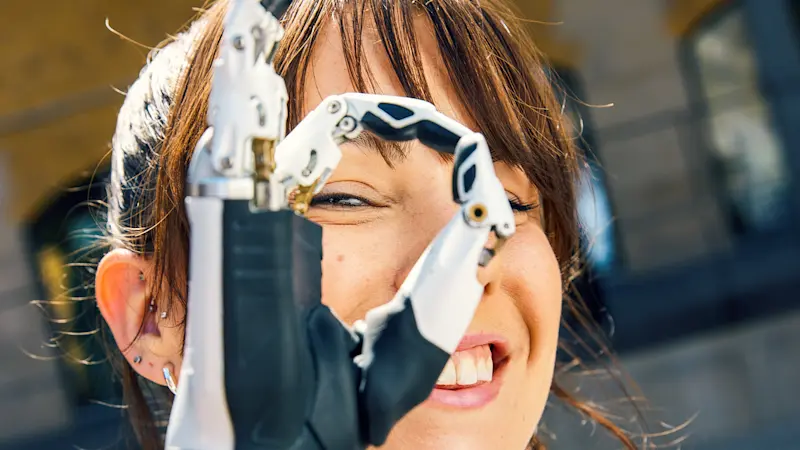
Modular system with myoelectric control.
The speedhand solution combines several modular components to form a compact fitting solution:
speedhand prosthesis
Modular prosthetic wrist joints
myosmart control
myosmart cuff and
connectgrip app
This allows Ottobock’s speedhand solution to be customised by all hand prosthesis wearers who value simplicity and functionality.
At a glance.
Two to four non-invasive sensors on the skin record muscle activity in the residual limb and translate it into movement commands for the prosthesis.
The control can be individually adapted to the user’s muscle signals. This allows them to move the prosthesis at their own speed and even flex and extend the elbow.
The thumb automatically returns to a resting position when the speedhand is not in use. This not only gives the hand a relaxed and natural appearance, but is also helpful when putting on jackets.
Intuitive control of the upper arm prostheses through neurological integration.
Targeted muscle reinnervation (TMR) is a surgical method to improve prosthesis control in upper arm and shoulder fittings.
The nerves in the residual limb that previously controlled the arm and hand are removed from the surrounding tissue and connected to muscles in intact areas of the body. They can then grow into the pectoral muscle, for example. This allows patients to control their subsequent arm prosthesis using “thought signals”.
Nerves in the residual limb are assigned to new muscle groups
New control signals are generated
Improved control for complex movements
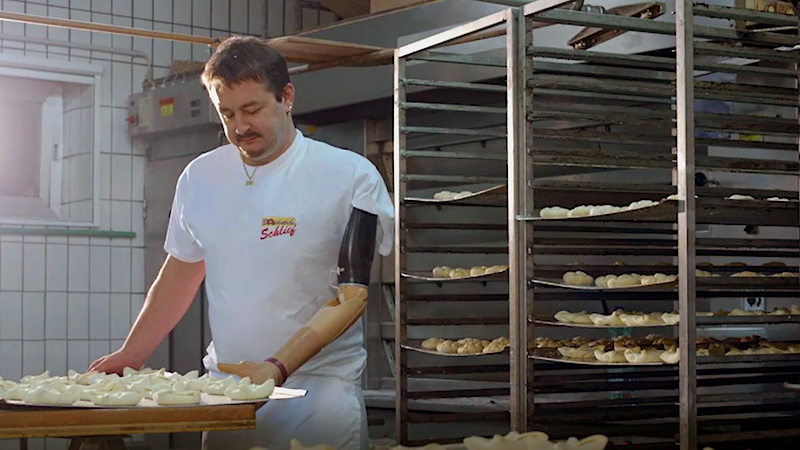
The TMR treatment process.
Considerably more complex and intensive than treatment involving a conventional prosthetic device
Individually tailored to the patient
Requires close cooperation between surgeons, O&P professionals and physiotherapists
Can take up to two years
Signals from the musculature control the hand.
When users imagine moving their phantom arm, the nerves transmit the signals to the new target musculature. Electrodes in the prosthetic socket record the signals. A processor analyses the signals and translates them into the intended movement in real time.
An example:
The thought of closing one’s fist activates muscle signals. The prosthesis performs the movement and the hand closes.
TMR enables:
Simultaneous control of several joints
Use of up to six electrodes to record muscle signals
Control of up to six movements with independent muscle signals
Intuitive, faster and more precise movements with the arm prosthesis
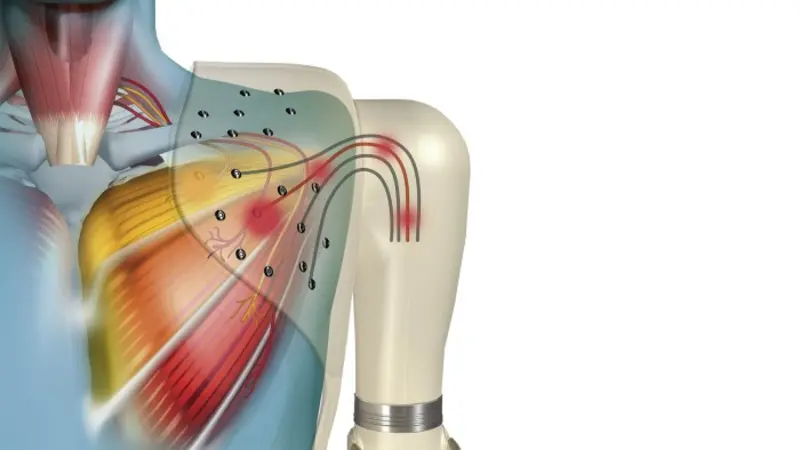
Advances in the human-machine interface.
Current developments are focusing on further developing the interface between human and prosthesis. The goal is to achieve control that is more intuitive, faster and more natural.
Innovative amputation medicine: How “rewiring” improves arm prosthesis control.
Dr Jennifer Ernst (Hannover Medical School) talks about modern amputation medicine and its role for the next generation of arm prostheses in Ottobock’s “Taste of Bionics” podcast. The focus is on methods such as targeted muscle reinnervation (TMR), osseointegration and the agonist-antagonist myoneural interface (AMI) that specifically reconnect nerves and muscles. These “rewiring” approaches improve signal transmission between the body and the prosthesis and facilitate much more intuitive control. At the same time, they address key challenges of conventional methods, such as limited control and phantom limb pain. Dr Ernst places the development in the growing field of neurotechnology and highlights how surgical innovations create the basis for future human-machine interfaces.
Dr Jennifer Ernst (Hannover Medical School) talks about modern amputation medicine and its role for the next generation of arm prostheses in Ottobock’s “Taste of Bionics” podcast. The focus is on methods such as targeted muscle reinnervation (TMR), osseointegration and the agonist-antagonist myoneural interface (AMI) that specifically reconnect nerves and muscles. These “rewiring” approaches improve signal transmission between the body and the prosthesis and facilitate much more intuitive control. At the same time, they address key challenges of conventional methods, such as limited control and phantom limb pain. Dr Ernst places the development in the growing field of neurotechnology and highlights how surgical innovations create the basis for future human-machine interfaces.
Phantom Neuro: How Phantom X is redefining prosthesis control.
In Ottobock’s “Taste of Bionics” podcast, Phantom Neuro CEO Connor Glass provides an in-depth insight into current developments in neurotechnology. Central to this is Phantom X, a minimally invasive interface that accurately records muscle signals, enabling intuitive control of prostheses. This neuro-based technology is addressing a key weakness affecting prosthesis controls up until now ‒ the fact that operating them is complex and not very natural. The podcast places this innovation in the growing field of human-machine interfaces and highlights its potential beyond medical technology – for example, for robotics and industrial applications.
In Ottobock’s “Taste of Bionics” podcast, Phantom Neuro CEO Connor Glass provides an in-depth insight into current developments in neurotechnology. Central to this is Phantom X, a minimally invasive interface that accurately records muscle signals, enabling intuitive control of prostheses. This neuro-based technology is addressing a key weakness affecting prosthesis controls up until now ‒ the fact that operating them is complex and not very natural. The podcast places this innovation in the growing field of human-machine interfaces and highlights its potential beyond medical technology – for example, for robotics and industrial applications.
Everything you need to know about AI-based prosthesis control.
Contact persons.
Additional topics.
Media information
Would you like to know more about our product highlights? Do you need high-resolution images for your publication? We have compiled product information and images for journalists here.
Would you like to know more about our product highlights? Do you need high-resolution images for your publication? We have compiled product information and images for journalists here.

Innovations for people
We have been conducting research for our users, patients and customers for more than 100 years – and setting new standards in medical technology with our intelligent solutions.
We have been conducting research for our users, patients and customers for more than 100 years – and setting new standards in medical technology with our intelligent solutions.

Ottobock clinical research
Our clinical studies are available for download here.
Our clinical studies are available for download here.
3 results out of 3